
Around the globe we see an increase of populations living in cities, making urban environments the fastest growing ecosystem on the planet. Urbanization is a global phenomenon that has been increasing at an accelerating rate, altering both terrestrial and aquatic landscapes. These alterations are often linked to biodiversity loss, but can urbanization also drive evolution? Well, many organisms that persist in urban areas are faced with new evolutionary pressures due to the rapidly changing environment of cities. Freshwater environments are especially affected by urbanization with decreasing water quality and the addition of chemicals.
A commonly over-looked phenomenon freshwater fish must adapt to is increased stream flow. The loss of vegetation and the replacement of soil with concrete and other impervious surfaces has increased runoff water from rain and storms leading to increased water velocities in streams (Rose & Peters, 2001). The body shape of fish has evolved to fit the environment they live in and water velocity is an important driver of diversification. For example, fish that live in streams with higher water flow tend to be narrower with longer and slimmer mid-bodies, making them more streamlined to reduce water drag and increase their ability for steady swimming. Slow-moving water environments favor body shapes that are more maneuverable and better burst swimmers, allowing them to switch directions faster and accelerate in order to avoid predators or catch prey (Haas et al., 2010). Researchers at North Carolina State University suspected that the body shape of fish inhabiting streams in urban areas, with increased water velocity, would have evolved a different body shape than their rural conspecifics. Making them pose the question: do urban populations show morphological differences in body shape to rural populations? (Kern & Langerhans, 2018).
To answer this question the researchers investigated two populations of Carolina freshwater stream fish: blacknose dace (Rhinichthys obtusus) and creek chub (Semotilus atromaculatus). They photographed 693 fish captured from 25 urban and rural streams. Using specific features along the body line of the fish they made geometric approximation of each fish’s body shape. The researchers compared the body shapes of the urban and rural populations of both species.

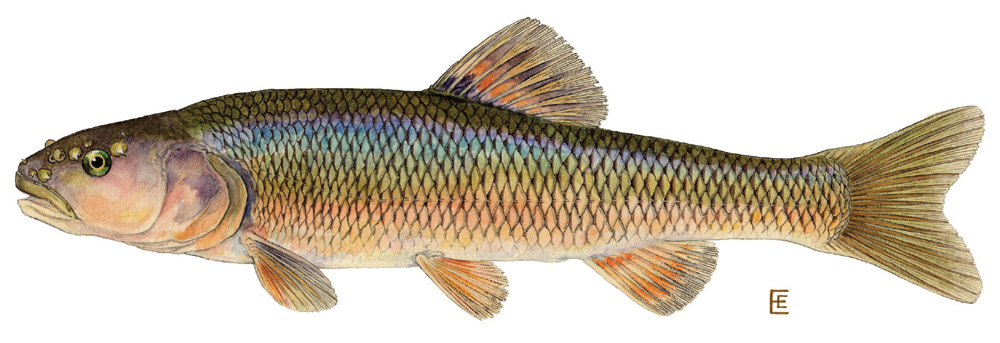
The researchers were expecting urban populations to have a more streamlined body shape to accommodate for the increased water speeds. The results for both species showed a different body shape between the urban and rural populations. As expected, the urban blacknose dace evolved a more streamlined body, characterized by a longer, shallower midbody, an eye position closer to the snout, and fins shifted closer to the snout. In contrast, the urban creek chub populations followed a strategy the researchers did not expect, developing a deeper midbody with ventrally shifted pelvic and anal fins, as well as a longer midbody and a shorter head, a less slimer body not resembling the streamlined body type thought to feet this environment.
But how are we certain that the morphological changes are caused by urbanization? To clarify this, researchers examined creek chub specimens from museums that were collected from the same sites dating back to 1960. The same geometric method was applied to analyze their body shapes and using historical data of the locations three categories were made: historically rural, historically urban and recently urbanized. Historically urban fish and historical rural fish had almost the same differences as the modern populations. The creek chub populations of recently urbanized areas used to exhibit the rural phenotype but have now evolved into an intermediate phenotype, showcasing the pressure of urbanization on body shape. The analysis of historical populations shows that urbanization has an effect on the evolution of these fish species, and increased stream flow has been re-shaping the creek chub for decades. Although the morphological changes in creek chub were not exactly as anticipated, the shift of the recently urbanized populations is evidence of a causal relationship between urbanization and body shape.
Urbanization is rapidly changing the environmental conditions of the world around us. It is increasingly clear that urbanization is exerting evolutionary pressures that drive physical changes in different freshwater stream fish. However, the evolutionary strategies implemented by each organism seem to be more species specific than we originally thought. Understanding the impacts urbanization has on evolutionary pressures, and the resulting interactions with organisms, is crucial for understanding environmental and evolutionary dynamics to improve efforts to protect and conserve them as well as their habitats. The role of urbanization as a driver of evolution is massively underestimated. This study from Kern and Langerhans highlights how urbanization should not just viewed only as a threat to biodiversity but also as a force of evolutionary change. Urbanization doesn’t just alter the environment that humans live in but has an unseen impact on the fundamental interactions that have govern life from its existence. We should proceed with caution and awareness of the changes urbanization brings to our world.
References
Haas, T. C., Blum, M. J., & Heins, D. C. (2010). Morphological responses of a stream fish to water impoundment. Biology Letters, 6(6), 803–806. https://doi.org/10.1098/rsbl.2010.0401 https://royalsocietypublishing.org/doi/10.1098/rsbl.2010.0401
Kern, E. M. A., & Langerhans, R. B. (2018). Urbanization drives contemporary evolution in stream fish. Global Change Biology, 24(8), 3791–3803. https://doi.org/10.1111/gcb.14115 https://onlinelibrary.wiley.com/doi/10.1111/gcb.14115
Rose, S., & Peters, N. E. (2001). Effects of urbanization on streamflow in the Atlanta area (Georgia, USA): a comparative hydrological approach. Hydrological Processes, 15(8), 1441–1457. https://doi.org/10.1002/hyp.218 https://onlinelibrary.wiley.com/doi/10.1002/hyp.218
Featured photo: © Christin Ferrer


- Urbanization and the re-shaping of fish. - September 2, 2025
- Spotlight on foraging behaviour of nocturnal rodents - June 9, 2025
Leave a Reply