


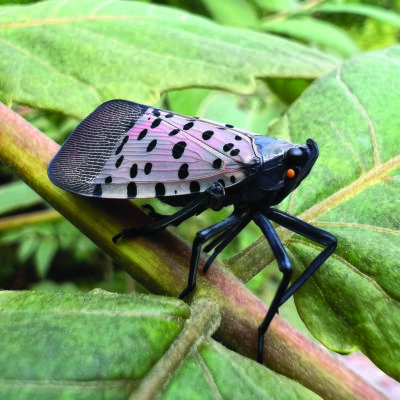
If you live in the Northeast United States, the Spotted Lanternfly (Lycorma delicatula) probably needs no introduction. Since their arrival around 2014, these striking planthoppers have transformed from a localized curiosity in Pennsylvania into a region-wide phenomenon, swarming vineyards, coating city sidewalks, and becoming the target of public “squish-on-sight” campaigns. But as evolutionary biologists, we look at these swarms and see something else entirely: a paradox.
The Genetic Paradox of Invasion
Invasion biology is often haunted by a concept known as the “Genetic Paradox of Invasion.” Classically, we expect that when a species is introduced to a new environment, it starts with a very small number of individuals. This creates a “population bottleneck,” stripping away the genetic diversity that populations usually rely on to adapt to new challenges. Theory suggests that these inbred, genetically impoverished populations should struggle to survive (Estoup et al., 2016).
Yet, the spotted lanternfly is thriving in its invasive range. In our latest research, published in Proceedings of the Royal Society B, the Winchell Lab set out to solve this puzzle.
To understand the mechanism underlying this successful invasion, we sequenced the whole genomes of spotted lanternflies from their invasive range in the U.S. and compared them to populations in their native range in China. First, we confirmed that the genetic paradox indeed exists for this species: the invasive U.S. population exhibits significantly reduced genetic diversity and elevated inbreeding.
Using demographic modeling to reconstruct their history, we confirmed the previously proposed scenario of a single introduction to the U.S. via South Korea around 2014. However, our data also revealed a third, previously unknown bottleneck that occurred more than 170 years ago, a period coinciding with the rapid urbanization of Shanghai. These three severe bottlenecks may explain why the U.S. population has such low genetic diversity.
If They Have Low Diversity, Why Are They Winning?
This brings us to the core of the mystery: how does an inbred, single-introduced population with limited genetic variation manage to adapt and spread to a novel environment so rapidly?
We suspected the answer lay in natural selection.
We scanned the genomes of spotted lanternflies in their native range in different ways. Surprisingly, we found that urban and rural populations in Shanghai are genetically diverging, even when separated by distances as short as 30 to 40 kilometers. In the urban center, we detected strong signals of selection on genes related to reproductive processes, pathogen defense, and more. But the story doesn’t end in China. When we looked at the invasive population in the U.S., we found that despite the severe genetic bottleneck, evolution is still hard at work. We identified signatures of selection in genes related to metabolic regulation and climate adaptation. As the invasion expands northward, we see functional enrichment in genes related to cold sensing and rapid cold-hardening, as well as genes related to thermal stress.
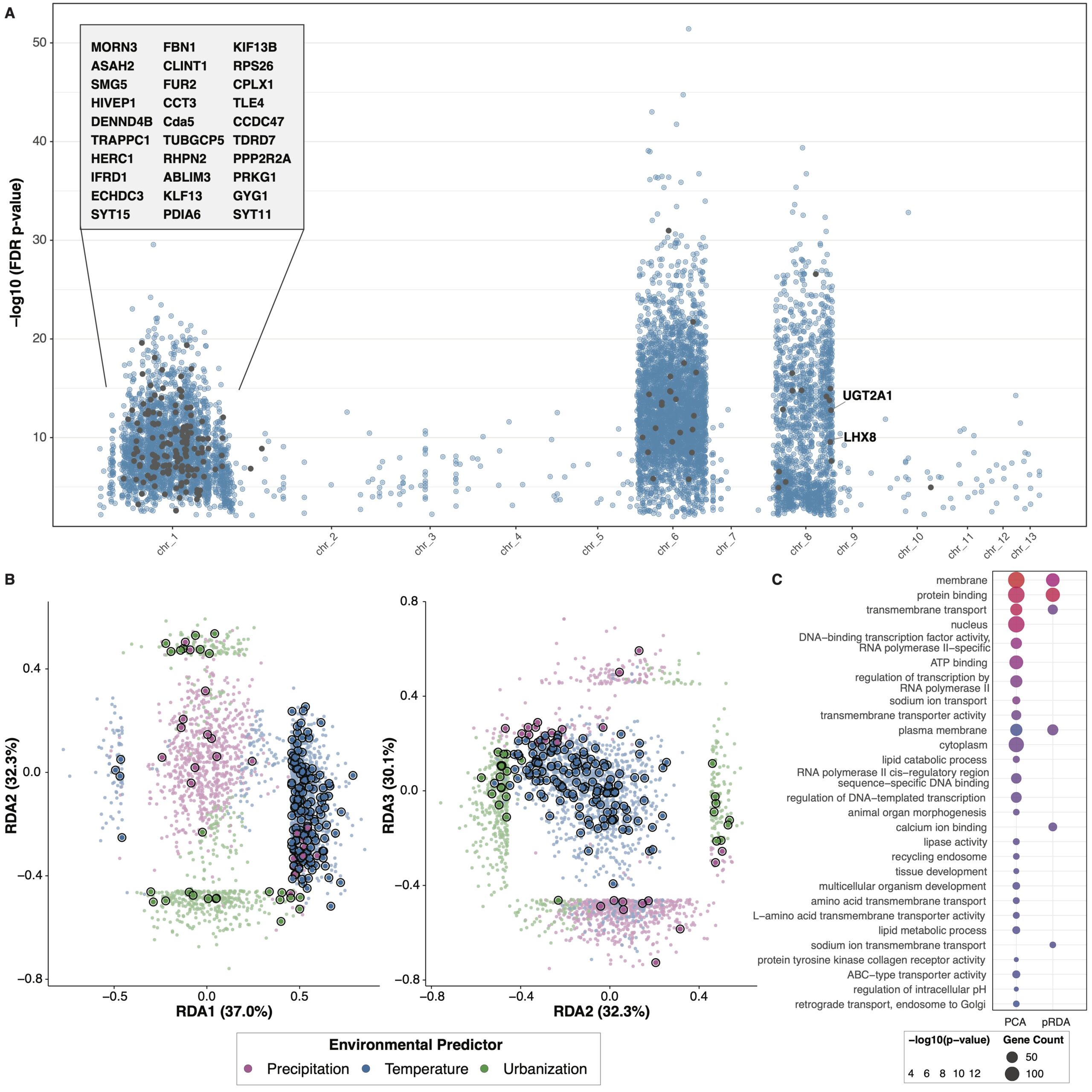
For example, Figure 6 from our paper illustrates how environmental adaptation is driving selection in the invasive range. The results were clear: temperature and precipitation are significant forces shaping the genetic variation of the U.S. population. We identified specific genomic signatures in stress response pathways, such as genes involved in calcium ion binding, a mechanism crucial for cold sensing and rapid cold-hardening as the invasion moves north. We also detected selection on genes involved in metabolic regulation (ECHDC3, GYG1, ASAH2) and thermal stress (PDIA6), which likely fuel their rapid establishment in varying climates. Crucially, we found selection signals related to how insects handle toxins, including sodium ion transport genes and UGT2A1, a gene also associated with urbanization in Shanghai and insecticides resistance in many exsiting literature. These patterns confirm that despite demographic constraints, natural selection may help the Spotted Lanternfly deal with the novel challenges of the Northeast U.S.
The “AIAI” Connection: the role of cities
Even more striking was the discovery that these evolutionary strategies are not unique to one region. We found that spotted lanternflies are adapting in parallel across both their native and invasive ranges. In both China urban and the U.S. populations, we identified strong signatures of selection in genes related to detoxification and pesticide resistance. This suggests that the pressures of city life, whether it is exposure to synthetic insecticides or the need to detoxify novel host plants, are driving similar evolutionary responses on opposite sides of the globe. These findings align with the Anthropogenically Induced Adaptation to Invade (AIAI) hypothesis (Hufbauer et al., 2012), reinforcing the idea that human-altered environments are actively shaping the genetic toolkit of invaders.
Cities globally share remarkably similar characteristics: heat islands, pollution, fragmented landscapes, and high pesticide use. This similarity means that an organism adapted to the “concrete jungle” of Shanghai is largely pre-equipped to thrive in the “concrete jungle” of New York or Philadelphia.
This perspective fundamentally shifts how we assess the risk of future invasions. We often blame global trade for simply moving organisms around, but we overlook the biological role of the infrastructure itself. Cities aren’t just transportation hubs; they are evolutionary incubators. By creating harsh urban environments, we are inadvertently selecting for traits, like heat tolerance and toxin resistance, that craft the perfect invader.
The spotted lanternfly is just one case, but it acts as a blueprint for life in the Anthropocene. It demonstrates that urbanization and biological invasion are not separate threats, but compounding forces. As we continue to pave the planet, we risk selecting for a new class of ‘super-invaders’: species that are not only comfortable around humans but are evolutionarily optimized for the world we have built. Understanding this process might be the only way we will be able to predict, and eventually manage, the ecosystems of the future we live in.
Read the full paper: “Cities as evolutionary incubators for the global spread of the Spotted Lanternfly” in Proceedings of the Royal Society B. DOI 10.1098/rspb.2025.2292
Estoup A, Ravigné V, Hufbauer R, Vitalis R, Gautier M, Facon B. 2016 Is there a genetic paradox of biological invasion? Annu. Rev. Ecol. Evol. Syst. 47, 51–72. (doi:10.1146/annurev-ecolsys-121415-032116)
Hufbauer RA, Facon B, Ravigné V, Turgeon J, Foucaud J, Lee CE, Rey O, Estoup A. 2012 Anthropogenically induced adaptation to invade (AIAI): contemporary adaptation to human-altered habitats within the native range can promote invasions. Evol. Appl. 5, 89–101. (doi:10.1111/j.1752-4571.2011.00211.x)

Leave a Reply