

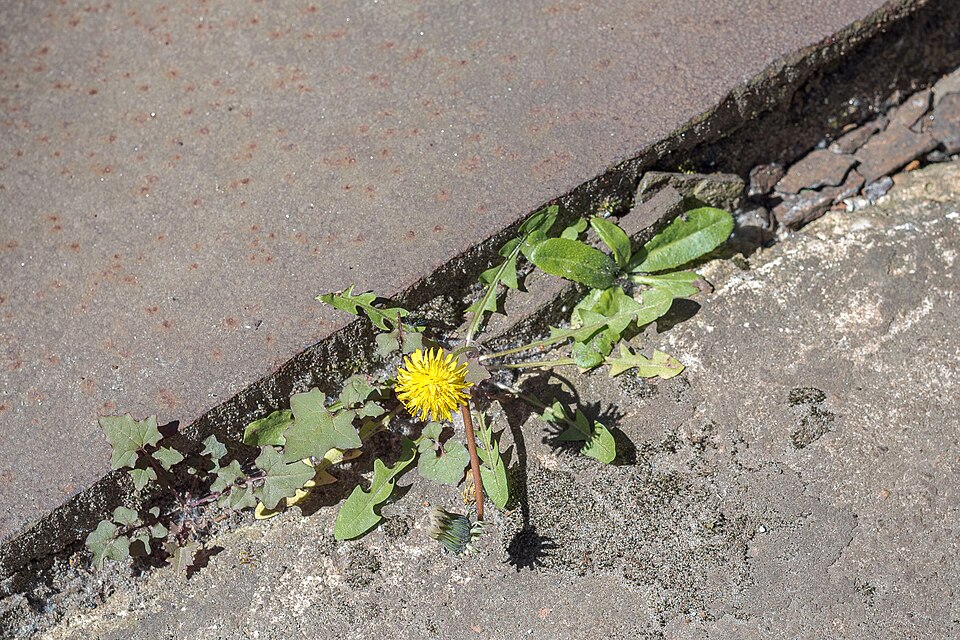
We all live in a highly urbanised world. We might even call our grey surroundings the asphalt jungle. Some cinema fans might think of the 1950s movie which starred Marilyn Monroe, but I just think of our own surroundings that are filled with concrete in all fifty shades of grey. We are all too familiar with the asphalt and concrete, but how many of us are truly familiar with the jungle? When thinking of the jungle I imagine a green, lush full place with plants stretching until the horizon, however in the city finding a plant is more like a game of Where’s Waldo. The apparent absence of plants in the city has many reasons.
Plants have been around longer than cities and are used to growing outside of these urban areas. This means that the urban areas have challenges to overcome for plant life and thus acts like a filter. Causing the urban flora to be a filtered pool of plant species. According to Williams et al. (2008) these four filters are habitat transformation, habitat fragmentation, urban environmental condition and human preference. Habitat fragmentation and transformation happen in all ecosystems, but urban environmental conditions and human preference are of course unique to cities. Not all of this is bad news, our own preferences might even bring plants into our cities. But these urban conditions propose challenges that plants need to deal with.
Cities have different conditions than the natural world. Ranging from light pollution, different soil compositions and higher temperatures. These conditions favor different plants than outside the city. This means that plants inside the city will have different traits that help them to thrive in this environment. After looking at different research Williams et al. (2014) found that urban areas favor thermophilic species and drought tolerant species. So, if urban areas have different conditions and favor certain traits in plants, then is there a perfect urban plant?
In our quest to find the perfect urban plant, we will not look at a specific species, but rather at traits that are needed to successfully live and thrive in the city. Fortunately we do not have to do this ourselves as researchers have already done it for us. A study by Thompson and McCarthy (2008) looked at plants in Sheffield and Birmingham, two big cities in the UK. After comparing different traits of over 800 plants, they were able to construct an ideal urban plant. This successful urban plant is robust and has a dry, unshaded and base-rich habitat. So now that there is a blueprint for our perfect city plant, how does our concrete jungle look like then? Will it all just be the same plant type over and over? Will there even be diversity? Or will we only find a diverse array of plants in the flower shops down the street?

Luckily we do not yet have to go running to the flower stores to appreciate some nice diverse plants in our cities. Our perfect plant is just some perfect traits that are useful to have, and these traits can be found in different species. For instance, both lavender and geraniums can handle drought quite well, but they look completely different from each other. So similar traits do not mean similar looks. While it is true that some species, like annual meadow grass (Poa annua) do appear in cities all over the world, not all species are this widespread, so every city will have at least some different plants. Most cities also are big places and so they can harbour a big amount of plant species. So while a hypothetical perfect urban plant does exist, in reality lots of species are considered to be successful urban plants.
To see that there are a lot of these successful urban plants, let me introduce the beautiful city Plzeň. It is one of the largest cities in the Czech republic, home to football club FC Viktoria Plzeň, birthplace of Peter Grünberg and it rapidly industrialized in the 19th century. One would expect that this industrialization over the years would massively decrease the plant life in this city. However that is not the case. As mentioned before there are a lot of successful urban plant species and a study by Chocholoušková and Pyšek (2003) shows just how many there are. From 1880 until 1990 there was a net loss of 130 species, going from 1173 species to 1043. Of course species come and go, so more than 130 species went extinct but this gap was filled by other new species that immigrated. However a whopping amount of 805 species were permanently present during this entire time period. This shows just how many good urban plants truly exist.
So, not all hope is lost and our cities might not look as vibrant as the jungle, but there is certainly still a lot of plant diversity to be found. So next time when walking around in your own city, try to look around and see the diversity of the plant life among us. And when you really pay attention then you will notice that finding plant life is way easier than finding Waldo.
References
Williams, N. S., Schwartz, M. W., Vesk, P. A., McCarthy, M. A., Hahs, A. K., Clemants, S. E., Corlett, R. T., Duncan, R. P., Norton, B. A., Thompson, K., & McDonnell, M. J. (2008). A conceptual framework for predicting the effects of urban environments on floras. Journal Of Ecology, 97(1), 4–9. https://doi.org/10.1111/j.1365-2745.2008.01460.x
Williams, N. S., Hahs, A. K., & Vesk, P. A. (2014). Urbanisation, plant traits and the composition of urban floras. Perspectives in Plant Ecology Evolution And Systematics, 17(1), 78–86. https://doi.org/10.1016/j.ppees.2014.10.002
Thompson, K., & McCarthy, M. A. (2008). Traits of British alien and native urban plants. Journal Of Ecology, 96(5), 853–859. https://doi.org/10.1111/j.1365-2745.2008.01383.x
Chocholoušková, Z., & Pyšek, P. (2003). Changes in composition and structure of urban flora over 120 years: a case study of the city of Plzeň. Flora, 198(5), 366–376. https://doi.org/10.1078/0367-2530-00109

