

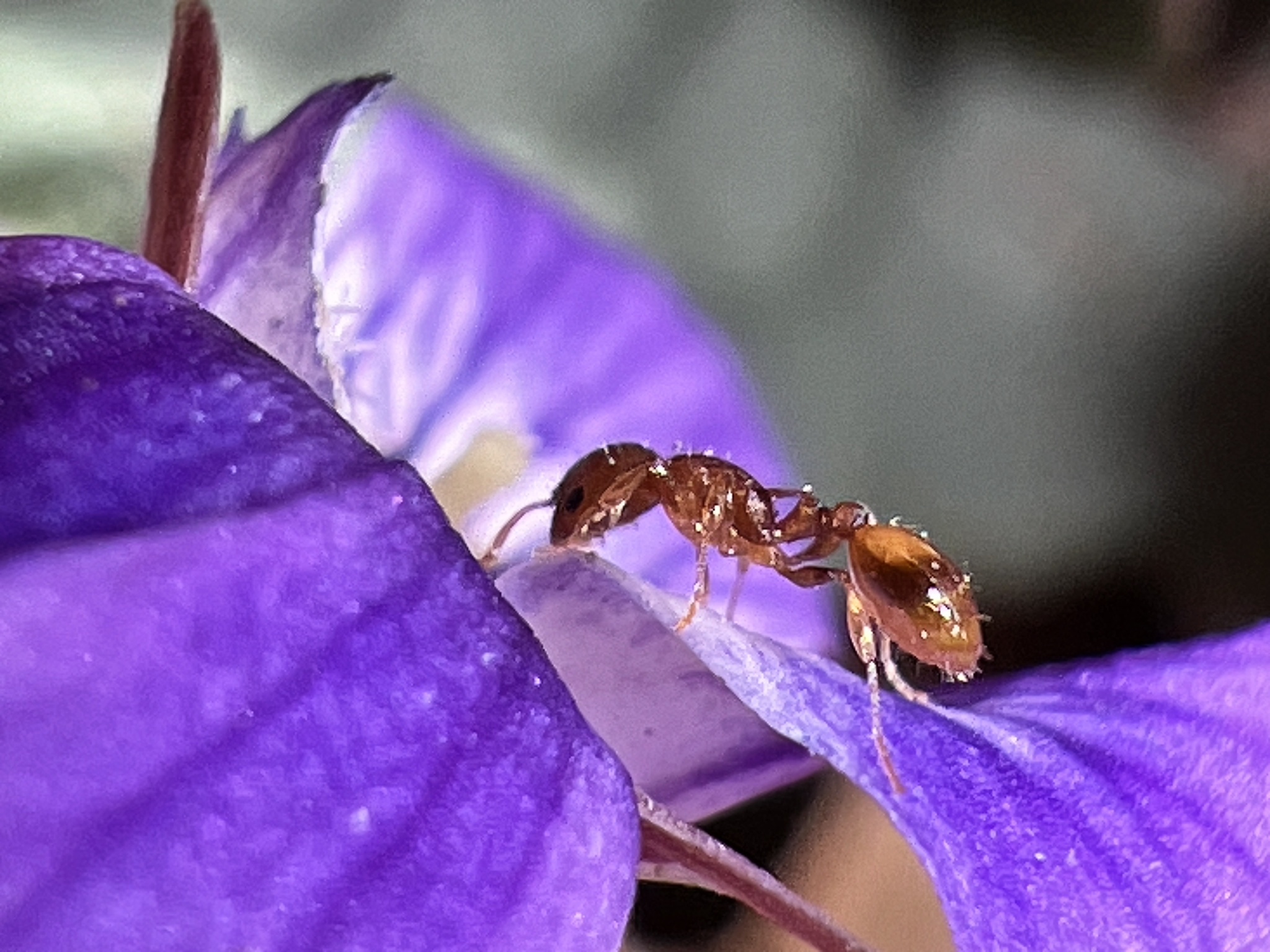
Around 100 million years ago, long before humans evolved, the first cities were built on earth [1]. Although these cities were not visible from space, they did already influence the world around them. These infrastructures were built by a small insect which is still around today, the ant. These ant cities played, and still play, a key role in supporting the growth of plants. The ants move organic matter and create tunnels into the earth, providing nutrients and air for plant roots. However, another animal has taken over the role as major landscaper of this world, and it is us, humans. The cities we build create a warm concrete environment where most of the green is pushed out. Nevertheless, ants, particularly the acorn ant (Temnothorax curvispinosus), are adapting rapidly to these newly created habitats, showing that ants are not only engineering their environment but also evolving alongside it.
Who are these acorn ants?
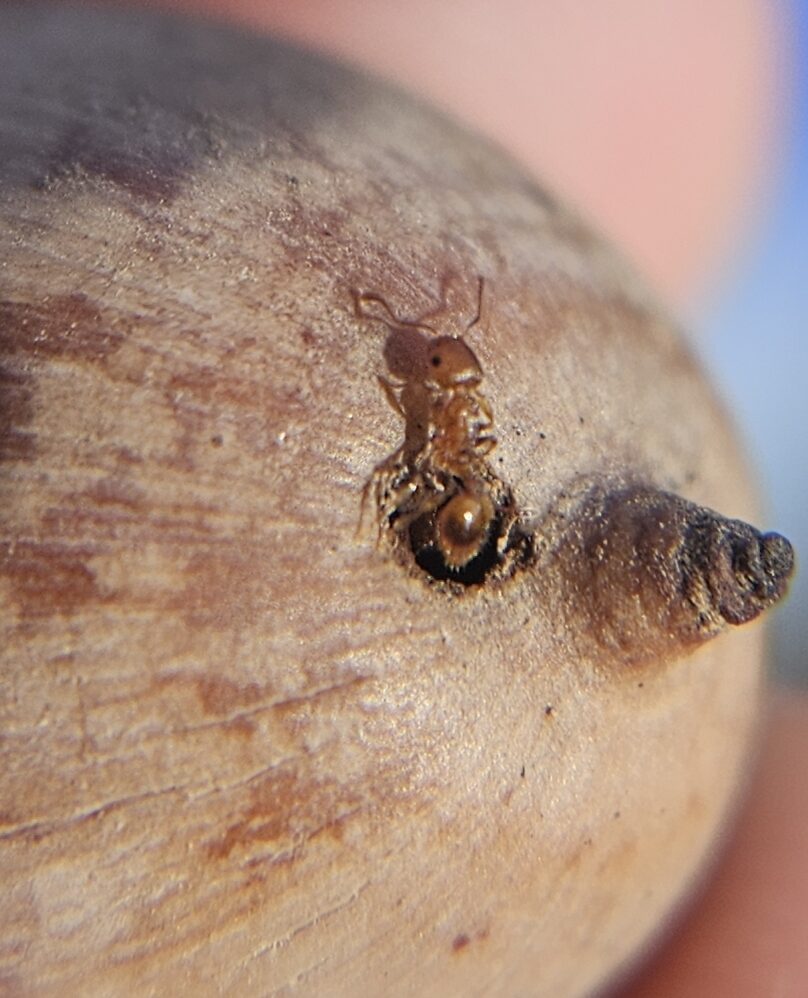
Acorn ants build nests in a large variety of places from soil to hollow plant stems and even, as their name suggests, in acorn nuts [2]. These nesting habits allow them to find a suitable location to build a nest, even if the surrounding area consists of almost only concrete. Colonies typically consist of around 100 workers with several queens but can go up to almost 400 workers. To sustain this number of workers, the colony feeds itself on any organic material it can find, from nectar to dead insects.
What sets them apart?
The living habits of these ants are not the only part that allows them to thrive in cities. A small change happened in the genome of these ants, primarily within acorn ant colonies that have been established in cities for a longer time. The change allows them to adapt more quickly to heat. This is beneficial in cities as temperature can rise rapidly and vary considerably within a small area [3]. Interestingly, the trait is passed on to the next generation of ants, even if they themselves are not living in an urban area. However, urban acorn ants are less cold tolerant than their rural kin. Moreover, a hybrid between an urban and rural ant showed both the heat tolerance and cold tolerance of its parents [4].
A new species in the making?
The way these traits were given to their offspring sparked the interest of scientists, as this could possibly be evolution of a new species in real time. The changes in heat and cold tolerance within species are mostly the result of epigenetics, the process by which cells switch genes ‘on’ and ‘off’ in reaction to the surrounding environment. In ants this is very noticeable when the ant queen lays female eggs. These eggs are genetically the same, but these eggs hatch into a worker, soldier or queen, depending on small cues like diet, pheromones, and temperature. However, an article published by Evolutionary Applications in 2019 written by Dr. Ryan Martin and colleagues found that the heat and cold tolerance of acorn ants was passed on to their offspring even under different conditions than those of their parents. With the hybrids; the type of nest where they grew up did not affect their tolerance, making it likely the result of a change in the DNA of the acorn ants. Still, only a small change in DNA does not yet create a new species as both the urban and rural variants can still produce viable offspring. The hybrids were even better than their parents at regulating temperature. Yet these hybrids do not occur in nature. The urban acorn ants mate one month earlier than the rural acorn ant. This is called reproductive isolation. Reproductive isolation can lead to new species emerging over longer timescales. Since DNA changes over time, due to mutations, urban and rural ants’ DNA will slowly become less similar and eventually become incompatible with each other.
The acorn ant has no say in the world it finds itself in. It simply responds, generation by generation, to the environment we create. That quiet, unconscious process, happening under the paved roads, reminds us that our cities reach far beyond their intended borders. Every road, every rooftop, every patch of asphalt sends ripples through the living world around it. Understanding that is the first step. Designing cities that leave room for nature, not as an afterthought but as a foundation, might just be the next one.
References
- E. O. Wilson and B. Hölldobler, “The rise of the ants: A phylogenetic and ecological explanation,” Proc. Natl. Acad. Sci. U. S. A., vol. 102, no. 21, pp. 7411–7414, May 2005, doi: 10.1073/pnas.0502264102.
- M. M. Prebus, N. Nguyen, G. N. Doering, and D. B. Booher, “Temnothorax caryaluteus sp. nov. (Hymenoptera: Formicidae): a new ant species from the eastern United States,” Eur. J. Taxon., vol. 970, pp. 175–202, Dec. 2024, doi: 10.5852/ejt.2024.970.2757.
- S. E. Diamond, L. D. Chick, A. Perez, S. A. Strickler, and C. Zhao, “Evolution of plasticity in the city: urban acorn ants can better tolerate more rapid increases in environmental temperature,” Conserv. Physiol., vol. 6, no. 1, p. coy030, Jun. 2018, doi: 10.1093/conphys/coy030.
- R. A. Martin, L. D. Chick, A. R. Yilmaz, and S. E. Diamond, “Evolution, not transgenerational plasticity, explains the adaptive divergence of acorn ant thermal tolerance across an urban–rural temperature cline,” Evol. Appl., vol. 12, no. 8, pp. 1678–1687, Jul. 2019, doi: 10.1111/eva.12826.
Featured Image:
