

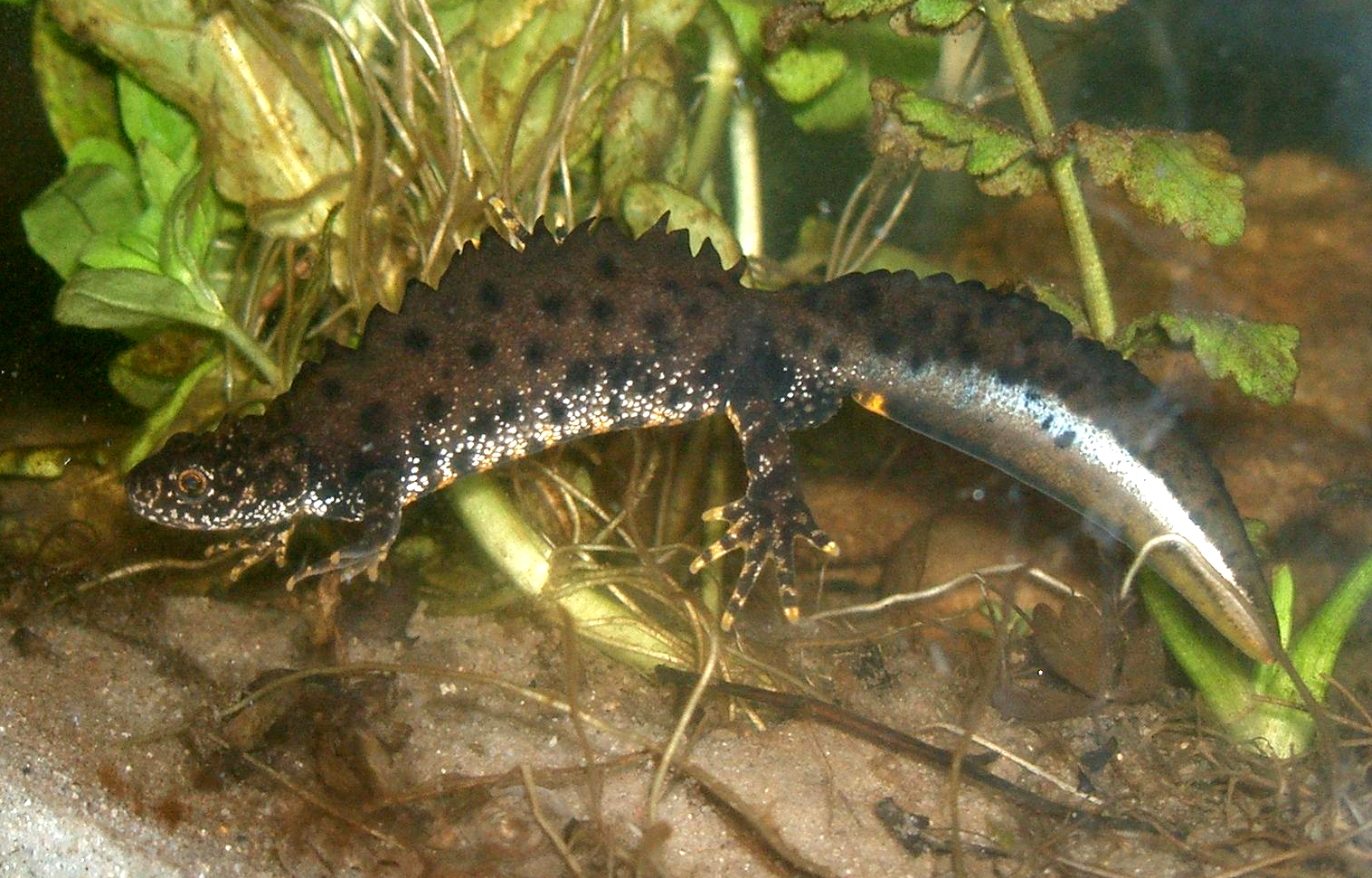
In cities, nature rarely disappears completely, it simply gets rearranged. For the great crested newt (Triturus cristatus), urban landscapes form networks of breeding ponds separated by roads, buildings, and other barriers. At first glance, these ponds may seem like isolated habitats, but they are actually part of a larger connected system. Newts move between them to breed, feed, and overwinter. In more natural landscapes, movement between ponds keeps populations connected. In urban environments, however, that connectivity begins to break down. Roads cut through migration routes, distances between ponds effectively increase, and dispersal becomes much riskier. Over time, what was once a connected pond network begins to turn into a set of partially isolated clusters. This raises an important question: what does this mean not only for the survival of urban newts, but for their long-term evolution?
At the heart of this issue is gene flow – the exchange of genes between populations through dispersal and reproduction. As long as individuals can travel between ponds and successfully reproduce, populations remain genetically connected. But once that movement becomes restricted, this balance begins to shift. Small, isolated populations become more vulnerable to genetic drift, where random changes in gene frequencies gradually reduce genetic diversity and increase the risk of inbreeding. For the great crested newt, this is especially important, as its survival depends on moving between breeding ponds through the surrounding terrestrial habitat, making barriers in urban landscapes particularly difficult to overcome. Roads do not just fragment habitat, they also increase mortality during seasonal migration and reduce the chances of successful dispersal. In this sense, urban infrastructures can quietly reshape the genetic structure of populations, even when breeding ponds themselves remain untouched.
Several studies show that these effects are not just theoretical. Cox et al. (2021), studying the great crested newts in Belgium, found that populations in areas with higher road density showed lower genetic diversity and smaller effective population sizes, especially at very local scales of roughly 50 to 250 meters around breeding ponds. Rather than being driven by large-scale landscape change, these patterns emerged from fine scale urban structures in the immediate surroundings of ponds. Similar results have been reported in other pond-breeding amphibians. Garcia-Gonzales et al. (2011) showed that even minor roads can act as strong barriers to gene flow depending on a species’ ability to disperse. Building on this, Cox et al. (2023) compared the great crested newt with the smooth newt (Lissotriton vulgaris) and found that both species are affected by landscape fragmentation, but not equally. The great crested newt showed stronger genetic structuring, suggesting it may be especially vulnerable to urban barriers. Together, these studies suggest that fragmentation is often driven not by a single major obstacle, but by the combined effect of many small barriers scattered across urban space.
What becomes clear from these studies is that roads do more than alter movement in the short-term, they gradually reshape how populations are connected over time. For the great crested newt, there is currently no evidence that urban populations are splitting into separate species. However, reduced gene flow, increased isolation, and smaller effective population sizes are exactly the kinds of conditions under which evolutionary divergence can begin. This makes this topic both intriguing and relatively underexplored. While many urban ecology studies focus on whether species can survive in cities, these papers shed light on a deeper and less explored question: how cities may influence evolution itself? Roads may seem like ordinary features of city life, but for species like the great crested newt, they can quietly reshape genetic futures, reminding us that cities do not just change where wildlife lives, but also how it changes over time.
References
Cox, K., Denoël, M., Van Calster, H., Speybroeck, J., Van de Poel, S., Lewylle, I., Verschaeve, L., Van Breusegem, A., Halfmaerten, D., Adriaens, D., & Louette, G. (2021). Scale-dependent effects of terrestrial habitat on genetic variation in the great crested newt (Triturus cristatus). Landscape Ecology, 36(10), 3029–3048. https://doi.org/10.1007/s10980-021-01297-5
Cox, K., Schepers, R., Van Breusegem, A., & Speybroeck, J. (2023). The common ground in landscape effects on gene flow in two newt species in an agroecosystem. Conservation Genetics, 24(6), 807–826. https://doi.org/10.1007/s10592-023-01539-w
Garcia-Gonzalez, C., Campo, D., Pola, I. G., & Garcia-Vazquez, E. (2011). Rural road networks as barriers to gene flow for amphibians: Species-dependent mitigation by traffic calming. Landscape And Urban Planning, 104(2), 171–180. https://doi.org/10.1016/j.landurbplan.2011.10.012

